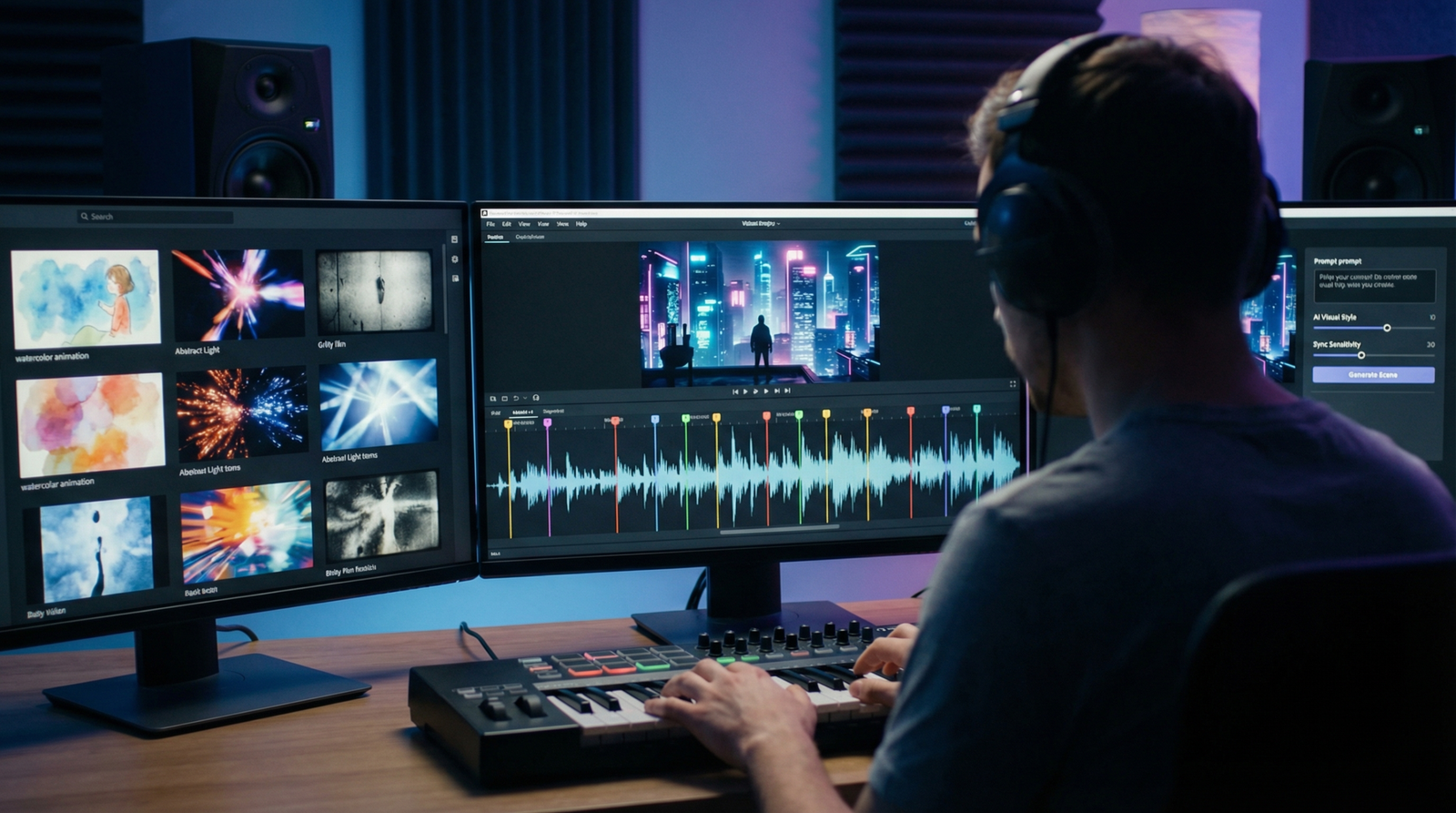
The best AI video generator tools in 2026 produce results that would have required a full production team just two years ago. Text prompts become cinematic clips. Still images animate into a dynamic video. Faces swap seamlessly across moving footage. The technology has crossed the threshold from impressive demo to practical production tool.
The real challenge now is choosing the right platform for your specific workflow. I tested seven leading tools across identical use cases — product showcases, portrait animations, social clips, and long-form narrative sequences — and evaluated each on output quality, pricing transparency, workflow integration, and whether the free tier actually delivers enough to make a fair evaluation. Here’s what I found.
At a Glance: Best AI Video Generator Tools of 2026
| Tool | Best For | Free Plan | Key Strength | Paid From |
| Magic Hour | All-in-one creators and teams | Yes, 400 credits (no expiry) | Full suite: video gen + face swap + lip sync | $10/mo |
| Runway Gen-4 | Cinematic professional output | Limited (125 credits/mo) | Visual quality and camera controls | $12/mo |
| Kling AI | Realistic motion and physics | Yes (daily credits) | Physical realism, camera direction | $8/mo |
| Pika | Social-native short clips | Yes (80 credits/mo) | Speed, effects, vertical format | $10/mo |
| Luma Dream Machine | Fast concept prototyping | Yes (30 generations/mo) | Generation speed and key frames | $29.99/mo |
| HeyGen | Business and multilingual avatar video | Limited (1 min/mo) | Spokesperson quality, voice cloning | $24/mo |
| Stability AI (SVD) | Developer pipelines and API use | Open source | Local deployment, no usage caps | Free (self-hosted) |
1. Magic Hour — Best AI Video Generator Overall
Magic Hour is the most complete AI video platform available in 2026. It doesn’t just generate video from a prompt — it connects that output to an entire content production pipeline: face swap, lip sync, talking photos, image animation, video extension, subtitle generation, and upscaling all sit in the same dashboard under the same credit system.
Using Magic Hour as your ai video generator means you’re not locked into a single AI model. The platform gives you access to multiple frontier models, so you can run the same prompt in parallel, compare outputs, and pick the best take before committing. That iteration advantage compounds quickly when you’re producing content at volume or testing ad variations.
The platform also includes a AI image editor tool within the same workflow, making it the only platform on this list where you can generate a video, swap a face, add lip sync, and export — all without switching apps or managing multiple subscriptions.
No account is needed to try anything. The free plan includes 400 credits with no expiration date — a policy that almost no other platform in this category offers.
Pros:
- No signup required to start — open the platform and generate immediately
- 400 free credits with no expiry, test at your own pace without billing pressure
- Multiple frontier AI models accessible from one dashboard with parallel generation
- One-click multi-step workflows: generate, upscale, and export in sequence
- Best-in-class face swap, lip sync, and talking photo tools in the same platform
- Full API parity across all tools for developer pipeline integrations
- Click-to-create templates for fast content workflow starts
- Weekly feature releases — the product roadmap ships consistently and quickly
- Optimized for both desktop and mobile with a consistent experience across devices
- Reliable performance at scale during live activations and traffic spikes
- Trusted by teams at Meta, NBA, Shopify, L’Oreal, Cisco, and Dyson
- Founder-level support quality at every plan tier
Cons:
- Free plan exports are capped at 576px with a watermark (1024px and above requires a paid plan)
- Not a traditional timeline editor — built for AI-driven generation workflows
- Some video generation modes are more credit-intensive than others
For creators and teams who want a single platform that handles the complete video generation pipeline without additional tools or logins, Magic Hour is the clearest recommendation in this category.
Pricing:
- Free: 400 credits, watermark, 576px resolution
- Creator: $15/month or $10/month billed annually — 120,000 credits/year, 1024px, all tools, no watermark, commercial use
- Pro: $45/month or $30/month billed annually — 360,000 credits/year, 1472px resolution
- Business: $99/month or $66/month billed annually — 840,000 credits/year, 4K on select modes, 10GB uploads
2. Runway Gen-4 — Best for Cinematic Quality
Runway remains the quality benchmark for professional AI video generation. Gen-4 produces visually consistent, cinematically grounded output that holds up in professional contexts — complex lighting, detailed environments, and realistic human motion all render at a level other platforms are still catching up to.
Pros:
- Highest visual output quality ceiling currently available in the category
- Strong prompt adherence on complex and detailed scene descriptions
- Camera control tools for specifying pan, dolly, and tilt behaviors
- Motion brush for directing movement within a specific region of the frame
- Active professional community with shared prompts and workflows
Cons:
- 125 free credits per month burns through quickly on longer or higher-quality clips
- Steeper learning curve than consumer-oriented tools
- Expensive at production scale — Pro tier runs $76/month
- Some generation modes are restricted on the free plan
For filmmakers and creative directors where visual quality is non-negotiable, Runway Gen-4 sets the standard. Be prepared to invest time learning the platform to get consistent results.
Pricing: Free (125 credits/month); Basic ~$12/month; Standard $28/month; Pro $76/month.
3. Kling AI — Best for Realistic Motion
Kling AI, developed by Kuaishou, has become the strongest tool for physically realistic motion in AI video generation. Cloth dynamics, hair physics, water movement, and natural human locomotion all render with a grounded quality that outpaces most competitors at this price point.
Pros:
- Best physical motion realism for fabric, water, hair, and human movement
- Explicit camera direction controls beyond prompt-only instruction
- Daily free credit refresh provides consistent access without a monthly cap reset
- Strong character consistency maintained across short sequences
- Globally accessible without regional restrictions
Cons:
- UI is less polished than Western-built consumer platforms
- Stylized or illustrated prompts animate less naturally than photorealistic inputs
- Complex scenes often require more iterations to get right than Runway
- Smaller community with fewer tutorials and shared resources
Kling is the right choice when your prompt requires grounded physical realism. Product cinematics, nature scenes, and fashion video all benefit from its motion quality.
Pricing: Free (daily credits); paid plans from ~$8/month.
4. Pika — Best for Social Content Creators
Pika prioritizes speed and social-native output, and it delivers on both consistently. Most text-to-video clips complete in under 60 seconds, and the Pikaffects library adds expressive visual transformations — fire, rain, explosions, morphing — that are specifically built for attention-grabbing social formats.
Pros:
- Fastest generation times for short-form social clips in the category
- Pikaffects add one-click creative transformations for social-native content
- Built-in lip sync included at all tiers including free
- Vertical format optimization for TikTok, Reels, and Shorts
- 80 free credits per month for consistent light use
Cons:
- Output realism trails Kling and Runway on complex or detailed scenes
- Limited camera control compared to dedicated tools
- 80 credits per month is thin for production volume work
- Free plan applies a watermark to all exports
For creators producing social video consistently at speed, Pika is the most efficient platform at this price point. The effects library alone makes it worth testing alongside any other tool on this list.
Pricing: Free (80 credits/month); Standard $10/month; Pro $35/month; Fancy $95/month.
5. Luma Dream Machine — Best for Fast Prototyping
Luma’s key frames feature — providing a start image and an end image for Luma to animate between — is one of the most useful innovations in the text-to-video category. It turns a two-image concept brief into a moving draft in roughly 90 seconds, making it the most practical tool for creative directors and storyboarders testing visual ideas.
Pros:
- Fastest generation speeds in the category, most clips completing in under 90 seconds
- Key frames feature creates smooth animated transitions between two source images
- 30 free generations per month provide real room for creative testing
- Strong performance on atmospheric, abstract, and stylized visual prompts
- Clean minimal interface with very low setup friction
Cons:
- Character and facial consistency trails Kling and Runway on realistic prompts
- Motion can feel imprecise on grounded, photorealistic scene requirements
- Limited fine-grained prompt control for technical users
- Not well-suited to structured narrative or dialogue-driven video
Luma gets you from a written idea to a shareable moving draft faster than any other tool on this list. It works best as a rapid-ideation layer before committing to a production-focused platform.
Pricing: Free (30 generations/month); paid plans from ~$29.99/month.
6. HeyGen — Best for Business and Multilingual Video
HeyGen focuses specifically on talking head and spokesperson video, and its output quality within that use case is polished and consistent. Voice cloning, multilingual lip sync across 130-plus languages, and a clean professional interface make it the strongest tool for teams producing localized or presenter-driven video content at scale.
Pros:
- Polished, professional output quality for spokesperson and presenter video
- Voice cloning delivers consistent character voice across multiple videos
- Multilingual support with accurate lip sync across more than 130 languages
- Clean interface designed for repeatable, scalable production
- Consistent results across repeated generations of similar content
Cons:
- Free plan covers only 1 minute of video per month — very limited for evaluation
- Pricing scales steeply for team and production-volume use
- Less suited to creative, cinematic, or social-native content formats
- Avatar outputs can feel slightly stiff on highly expressive audio inputs
For marketing teams producing consistent multilingual spokesperson or training video, HeyGen is the most capable business-oriented option currently available.
Pricing: Free (1 min/month); Creator $24/month; Team $69/month.
7. Stability AI (Stable Video Diffusion) — Best for Developers
Stability AI takes a fundamentally different approach: open weights, API-first, and designed for developers integrating video generation into their own applications. The model runs locally with appropriate hardware or via the Stability API, with no per-seat subscription and full parameter control.
Pros:
- Open-weight model available for fully self-hosted deployment
- API-first design for integration into any custom production pipeline
- No usage caps when running locally on owned infrastructure
- Full control over model parameters and output specifications
- Active research community with regular model updates
Cons:
- No consumer interface — requires technical setup and configuration
- Output quality at default settings trails managed cloud platforms
- Self-hosting requires meaningful GPU hardware investment
- Not practical for non-technical creators or small teams without engineering support
Stability AI is the right architecture when you’re building a product rather than just using one. For developers running video generation at scale within a custom pipeline, this is where to start.
Pricing: Free (open source, self-hosted); Stability API available on pay-per-use pricing.
How We Chose These Tools
I tested each platform using three consistent prompts: a product showcase scene, a walking human subject in a realistic outdoor environment, and an abstract atmospheric clip. Every tool was evaluated on its free tier first. Paid plan testing followed only where the free limit was too restrictive to form a reliable view of output quality.
Scoring criteria included: output quality and realism on real-world prompts, prompt adherence, generation speed, workflow integration depth, and the practical value of the free plan for a creator who hasn’t committed to a subscription yet. Tools that perform on optimal inputs but fail on real creative briefs consistently ranked lower.
The Market Landscape: What’s Shifting in 2026
Three clear trends define AI video generation as of early 2026:
Prompt-to-pipeline is the expectation. Standalone video generation is no longer enough. Creators expect to move from prompt to a finished, exportable asset — upscaled, face-swapped, and lip-synced if needed — without leaving the platform. Tools that don’t connect generation to post-production steps are losing users to those that do.
Multi-model access beats single-model depth. Platforms offering access to several frontier models in one place give creators more flexibility and better odds of finding the right output for each specific use case. Betting on a single proprietary model has become a harder sell.
API parity is becoming a baseline enterprise requirement. Marketing teams and developers want to run video generation programmatically at scale. Platforms built with API parity from the start are better positioned than those retrofitting developer access onto consumer-first tools.
Final Takeaway
- Best all-in-one platform — Magic Hour (multi-model, full pipeline, non-expiring free credits)
- Best for cinematic professional output — Runway Gen-4
- Best for realistic motion physics — Kling AI
- Best for social content at speed — Pika
- Best for fast concept prototyping — Luma Dream Machine
- Best for business and multilingual video — HeyGen
- Best for developer pipelines — Stability AI
Start with the free tier on your top two picks and run the same prompt through both. Quality differences are visible immediately on real briefs. I guarantee at least one of these tools fits exactly what you’re building.
Frequently Asked Questions
What is the best AI video generator in 2026?
Magic Hour offers the strongest overall combination of video generation quality, multi-model access, and workflow integration. The free tier includes 400 non-expiring credits with no signup required. For purely cinematic output, Runway Gen-4 is the quality benchmark.
Can I generate AI video for free?
Yes. Magic Hour (400 non-expiring credits), Kling (daily refresh), Pika (80 credits/month), and Luma (30 generations/month) all provide meaningful free access. Magic Hour’s non-expiring credit policy is the most practical for creators evaluating tools without a billing deadline.
Which AI video generator includes free face swap?
Magic Hour includes a free AI face swap tool directly alongside its video generator — the only platform on this list where you can generate a video and swap a face within the same workflow without additional tools or subscriptions.
How long does AI video generation take in 2026?
Most platforms complete 5-10 second clips in 60-120 seconds on paid plans. Pika and Luma are the fastest, often under 90 seconds. Magic Hour supports parallel generation, allowing multiple takes to run simultaneously and cutting total evaluation time significantly.
Do AI video generators support commercial use?
Most require a paid plan for commercial rights. Magic Hour’s Creator plan at $10/month billed annually includes full commercial use, making it one of the most affordable commercial entry points in the category.